
Seizures in Pets – Knowing the Signs and What to Do
What to do if your dog or cat has a seizure—emergency signs, START method, causes, and treatment options.
Seizures in pets can be alarming and distressing to witness. Understanding what seizures are, what causes them, and how they are treated can help you respond quickly and appropriately if your pet experiences one.
A seizure is caused by abnormal electrical activity in the brain. This can result in sudden changes in behavior, movement, consciousness, or muscle control.
What Does a Seizure in Pets Look Like?
Seizures can vary in severity and appearance. Signs may include:
- Collapse or falling to one side
- Muscle stiffness
- Paddling or jerking movements
- Drooling or foaming at the mouth
- Chewing motions
- Loss of consciousness
- Urinating or defecating involuntarily
- Staring spells, blank expression, or unusual repetitive behaviors
Seizures are generally classified as:
- Generalized seizures, which affect the whole body
- Focal (partial) seizures, which affect one area of the body or cause subtle behavioral changes
- Focal seizures that progress to generalized seizures
After a seizure, pets often go through a post-ictal phase, which may include confusion, temporary blindness, pacing, restlessness, or increased thirst and hunger. This dazed recovery period helps distinguish seizures from fainting episodes, as fainting animals recover instantly, whereas seizuring pets act disoriented for minutes to hours afterward.
When Is a Pet Seizure an Emergency?
Seek immediate veterinary care if:
- A seizure lasts longer than five minutes
- Your pet has more than two seizures in 24 hours (cluster seizures)
- Your pet does not regain consciousness between seizures
- Your pet has difficulty breathing or does not recover normally
Seizures lasting longer than five minutes (status epilepticus) or repeated cluster seizures are neurologic emergencies and require rapid medical treatment to prevent complications. Contact your family veterinarian immediately or take your pet to the nearest veterinary hospital like MedVet.
"Seizures lasting longer than five minutes or occurring back-to-back are medical emergencies that require immediate veterinary care."
– Jessica M. Kmiecik, DVM, Diplomate, ACVIM (Neurology)
What Should I Do If My Pet Has a Seizure?
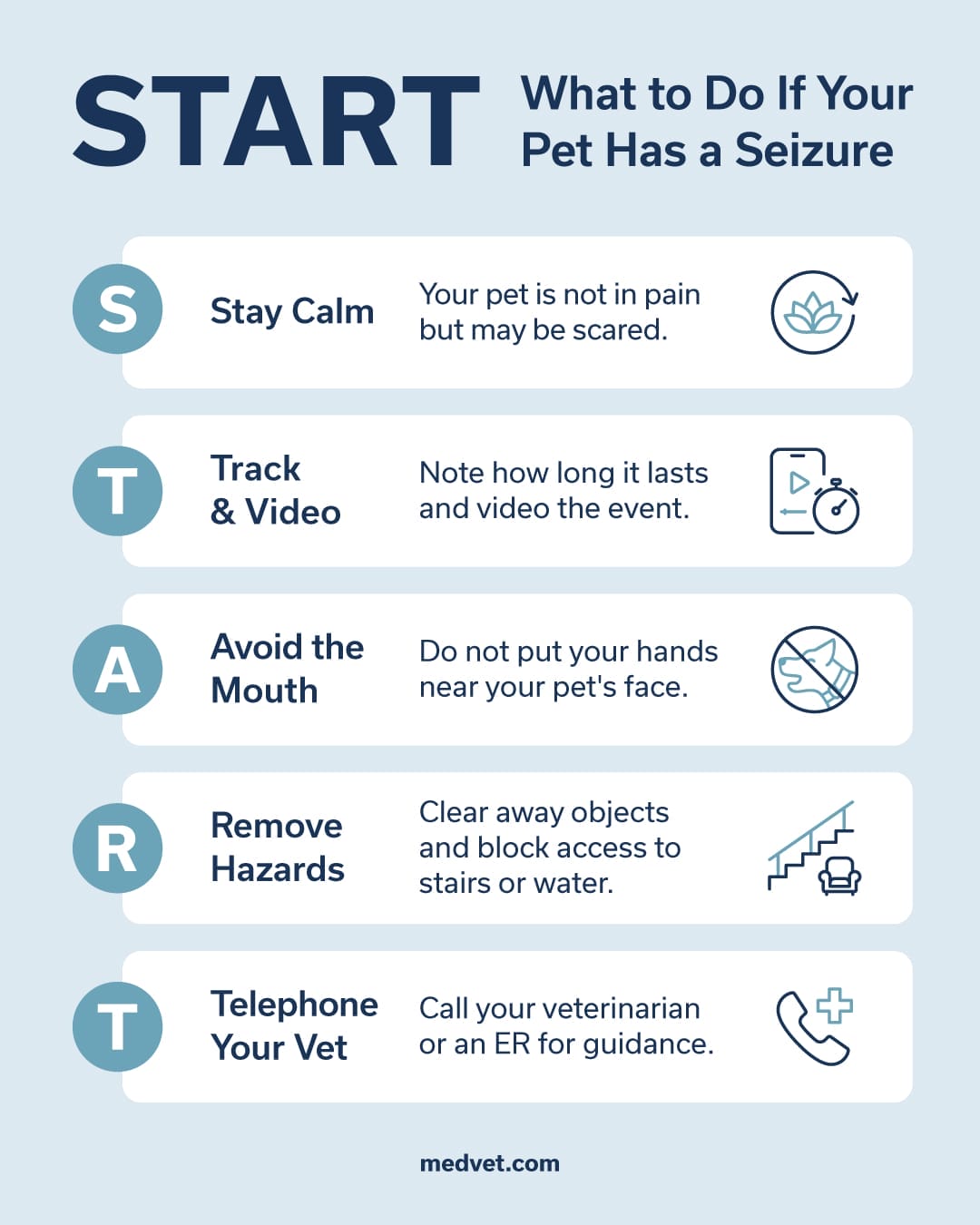
Use the START method to remember what to do:
S — Stay Calm
Your pet is not conscious of what is happening and is not in control of their movements or actions.
T — Track and Video
If possible, note how long it lasts and video the event. Seizures that continue for more than five minutes are emergencies. If the seizure does not stop on its own after three minutes, begin transporting your pet to an emergency facility.
A — Avoid the Mouth
Do not put your hands near your pet’s face. Contrary to myth, pets do not swallow their tongues, but they may bite unintentionally.
R — Remove Hazards
If your pet is near stairs or water, gently block access if it is safe to do so. Move furniture or sharp objects away to prevent injury.
T — Telephone your Veterinarian
Contact your primary veterinarian or an emergency hospital for guidance, especially if the seizure lasts longer than five minutes or your pet has multiple seizures.
If your pet has a history of seizures, your veterinarian may prescribe a rescue medication to administer at home for prolonged or cluster seizures. Intranasal midazolam or rectal diazepam can stop an active seizure safely and buy time until you reach veterinary care. These medications are used as directed and do not replace the need for veterinary evaluation. In other cases, oral levetiracetam or clorazepate may be administered too.
Seizures can have many causes, both extracranial or intracranial including:
- Low blood sugar (hypoglycemia)
- Liver disease
- Kidney disease causing uremic encephalopathy or stroke events
- Electrolyte imbalances
- Toxin exposure
- Head trauma
- Idiopathic disease
- Brain tumors
- Inflammatory brain disease
- Stroke in dogs and cats
Causes are often grouped into three categories:
- Reactive seizures: metabolic or toxin-related
- Structural seizures: caused by disease within the brain
- Idiopathic epilepsy: recurrent seizures with no identifiable structural or metabolic cause after diagnostic testing
Idiopathic epilepsy is one of the most common causes of recurrent seizures in dogs, particularly in young to middle-aged dogs. Certain breeds, including Golden Retrievers, Doodles, Poodles, German Shepherds, Australian Shepherds, and Huskys, often require more aggressive treatment and lifelong medication management.
Cats are more likely than dogs to have seizures caused by underlying structural brain disease, making thorough diagnostic workup especially important in feline patients.

How Are Pet Seizures Diagnosed?
Your veterinarian may recommend:
- Blood tests
- Urinalysis
- Blood pressure measurement
- Chest radiographs (X-rays)
- Abdominal ultrasound
- Imaging such as MRI
- Cerebrospinal fluid (CSF) analysis
Initial diagnostics focus on identifying metabolic or toxin-related causes. Advanced imaging and CSF analysis are recommended when structural brain disease is suspected, neurologic abnormalities are present between seizures, or seizures begin outside the typical age range for idiopathic epilepsy.
How Are Pet Seizures Treated?
Treatment for seizures depends on the underlying cause.
Emergency Treatment
Pets experiencing prolonged or repeated seizures require immediate intervention. First-line emergency therapy typically includes medications such as benzodiazepines, designed to quickly stop seizure activity. If seizures continue, additional anti-seizure medications and supportive care may be required. Hospitalization may be necessary for monitoring and stabilization.
When to Start Long-Term Medication
According to current ACVIM (American College of Veterinary Internal Medicine) guidelines, long-term antiseizure medication should be started if your pet:
- Has more than two seizures in six months
- Experiences cluster seizures (two or more seizures within 24 hours)
- Status epilepticus
- Has a single seizure that is severe, prolonged (longer than five minutes), or causes significant post-ictal dysfunction
- Has underlying structural brain disease
For pets between six months and six years of age with normal test results, your veterinarian may recommend monitoring after the first seizure, as some pets may never have another episode or may have only mild, infrequent seizures.
Common Medications for Long-Term Seizure Control
Available seizure medication options include:
- Phenobarbital
The most used first-line medication due to its effectiveness against the broadest causes of seizures and low cost. This medication requires periodic blood monitoring to check drug levels and liver function. Never stop phenobarbital suddenly, as this can cause severe withdrawal seizures.Phenobarbital can induce its own metabolism (autoinduction), which means the body clears the drug from the body more effectively, leading to poorer seizure control. It is common to increase the dosage of this medication over time.
- Levetiracetam (Keppra®)
This medication is a good option because it has minimal side effects and few drug interactions. Extended-release formulations allow for twice-daily dosing. It is particularly effective for feline audiogenic reflex seizures (sound-triggered seizures in cats) and works well for reactive seizures. No blood monitoring is required. - Zonisamide
A sulfonamide anticonvulsant with a high safety margin that works well for both focal and generalized seizures. May be used twice daily in dogs and possibly once daily in cats. Because it is a sulfa drug, it rarely causes dry eye issues or immune-mediated reactions. - Potassium bromide
A traditional first-line option that takes several months to reach stable blood levels. Requires blood level monitoring and can cause sedation or gastrointestinal upset. It should be avoided in pets with a history of pancreatitis.
Medication selection depends on the individual pet, seizure frequency, concurrent health conditions, and potential side effects. Some pets require combination therapy if seizures are not adequately controlled with a single medication.

Nutritional Support
Veterinary diets enriched with medium-chain triglycerides (MCTs) have been shown to support brain health and enhance seizure control as an adjunctive nutritional therapy. Ask your veterinarian about whether MCT-supplemented diets might complement your pet’s medication regimen.
The primary goal of treatment is seizure freedom. A response to treatment is reduction of seizures by 50%
If complete seizure freedom cannot be achieved, the secondary goal is:
- Prevention of cluster seizures and status epilepticus
- Relevant reduction in seizure frequency and severity
- Maintenance of good quality of life with minimal medication side effects
Complete elimination of all seizures is not always possible, and treatment focuses on providing the best quality of life for your pet.
Pet Seizure Monitoring and Follow-Up
Pets receiving certain antiseizure medications require periodic bloodwork to monitor drug levels and assess liver or kidney function. Adjustments may be needed over time to maintain safe and effective seizure control.
Keeping a seizure log that records the date, time, duration, and description of each episode can help guide treatment decisions. If your pet remains seizure-free for 12 or more months, tapering off medication may be possible in some cases—but this must be done gradually and only under veterinary supervision.
What Is the Prognosis for Pets with Seizures?
Prognosis depends on the underlying cause. Many pets with idiopathic epilepsy can live good quality lives with appropriate medical management. Pets with structural brain disease may have a more guarded prognosis depending on the condition and response to treatment.
Quality of life—including seizure frequency, recovery time, and medication side effects—is an important part of long-term treatment planning and should be discussed regularly with your veterinarian.
Visit our Pet Care Resources library for more pet health and safety information.
FAQs
Can a dog or cat die from a seizure?
Yes. Prolonged seizures (status epilepticus) or repeated cluster seizures can be life-threatening without emergency treatment.
Do pets feel pain during a seizure?
No. Dogs and cats are not conscious during generalized seizures and are not aware of pain while actively seizing.
What should I do if my dog or cat has a seizure at home?
Stay calm, time the seizure, keep your hands away from their mouth, remove nearby hazards, and contact your veterinarian—especially if it lasts longer than five minutes.
Are seizures more serious in cats than dogs?
Cats are more likely than dogs to have seizures caused by structural brain disease, which is why thorough diagnostics are especially important in feline patients.
Learn More
Veterinary neurologists treat brain, spinal cord, and nerve disorders.
Veterinary Neurology & NeurosurgeryShare




Contents
Learn More
Veterinary neurologists treat brain, spinal cord, and nerve disorders.
Veterinary Neurology & Neurosurgery